Family Archivist » News » Where do the family photos go?
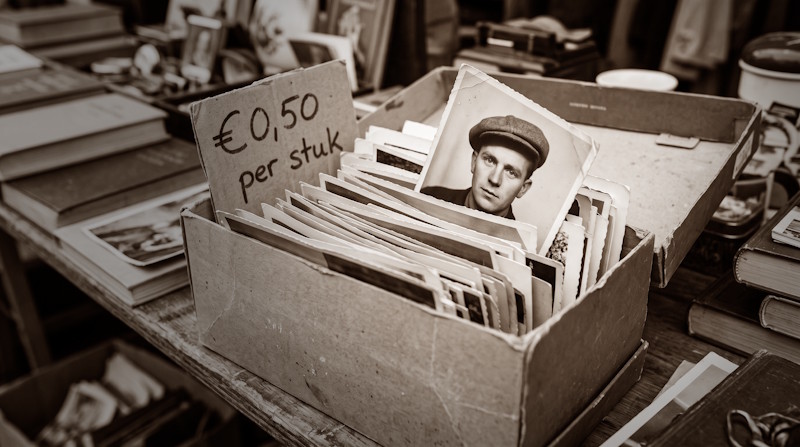
Every flea market has one: a box of loose photographs. A wedding couple from the 1930s, a class from an unknown school, a man with a horse in front of a farm. Nobody knows who they are anymore. Once they were someone's parents, someone's pride, someone's story at the kitchen table.
How big is that problem?
In the Netherlands alone, more than 170,000 people die every year. For many of them a house is cleared, with cupboards, albums and boxes full of photographs. If only half of those households kept a few hundred photos, that is tens of millions of photographs a year that need a new home. Some are shared out, some go to the charity shop, some go in the skip. That is an estimate, not a count, but the direction is certain: most of them do not survive.
And what certainly disappears is something that does not fit in a box: the knowledge about those photos. Who is in it? Where was this? Why did this photo always hang above the sofa? Those answers live in people's heads, and heads are not inherited. The photo sometimes survives. The story behind it almost never does.
What helps: let the family look along
That is exactly what more than five thousand family archivists do on Family Archivist. They put the photos and documents in a private family archive, invite brothers, sisters, cousins, nieces, nephews and uncles, and ask the question: who knows more about this?
What that yields can be seen in the most active archives:
- Family archive Dijkstra has existed since 2011: 1,990 photos, 62 participants and 2,721 comments. Comments are the answers: names, places, dates, memories.
- Family archive Oudenaarden-de Leeuw collected 1,170 photos and 40 stories with 71 participants.
- In the archive Postma en Greidanus 107 family members take part.
Together all family archives have now recorded 32,540 photos and scans, 1,487 stories and 9,236 comments. Not a family tree with only names and dates, but the family history as it was told at the table.
Starting is free
You create a family archive, add the first photos you would like to know more about, and invite a few family members. Participation is free for them and they need not know anything about family trees. The trial has no end date.
Start your family archive, for free
A good first photo is one you do not know everything about yourself. Add it with the question "Who knows where this is?". That is the post the family responds to.
Other news
- Koppel het digitale familiearchief aan uw publicatie op Genealogie Online
- Gratis een digitaal familiearchief uitproberen
- Profiel foto via webcam & bulk upload foto's/scans
- Familiearchivaris aan het woord: Dirk de Groot
- Vernieuwde vormgeving en vernieuwing bij inloggen
- Familiearchivaris aan het woord: Angelique Kuster
- Nieuw: archief ordenen en versturen van nieuwsbrieven
- Nieuw: familiearchief export, diapresentaties en zoeken
- Familie Archivaris is klaar voor gebruik